Website in a Week for Local Businesses: What Is Realistic?
Website in a Week for Local Businesses: What Is Realistic?
A website in a week for local businesses sounds like marketing. Sometimes it is. A fast website build is realistic for a local business that already knows its services, has its photos and reviews ready, and is happy to make decisions quickly. It is reckless for a business that has not thought through its services, its offer, or its call to action, because no design sprint will fix a vague brief in five working days.
This guide walks through what genuinely fits inside a one-week website sprint for a local business, what does not, what to watch out for when a vendor promises a website in a week, and how to decide whether a fast build is right for your business.
Quick answer
A website in a week is realistic when the brief is clear, the content is ready, and the goal is to replace an outdated or missing site with a sharper, conversion-focused version built around your services, trust signals, and clear calls to action. It is not realistic if the business still needs help defining its services, its offer, or its positioning, because strategy work takes longer than the build itself. The honest version of "website in a week" is a focused build with the strategy already agreed, not a strategy workshop plus a build crammed into five days.
Why a website in a week for local businesses became a popular promise
Fast website builds became popular for good reasons. Most local businesses do not need a six-month discovery process. They need a clean site that explains what they do, who they help, where they work, and how to take the next step. A focused sprint can produce that. The problem is that the phrase has been borrowed by agencies who use "in a week" as a marketing line, then quietly take a month, or who skip the strategy entirely and ship a template dressed up as custom work.
At Blend, we run Local Business Website Sprints for businesses that want a fast, conversion-focused rebuild without paying agency rates for a six-week project. We are honest about what fits in the week and what does not, and this guide explains how to think about the same offer from any provider.
What genuinely fits inside a one-week local business website sprint
A focused sprint can deliver a real result if the scope is realistic. Here is what usually fits, and what to expect from each piece.
Service pages that actually answer customer questions
The single biggest reason local business websites fail is thin service pages. A sprint can produce proper pages for your top three to five services, each one written to answer the questions a real customer asks. What the service includes. What it costs. Who it is for. Where it is available. How long it takes. What happens next. That work is not exotic. It is the difference between a site that produces enquiries and a site that just sits there.
A homepage that makes the next step obvious
Most local business homepages bury the next step under a long hero block, a stock photo, and a paragraph about the company. A sprint can replace that with a clear headline, a tap to call button, a short enquiry form, a reviews block, and a clear path to the top services. None of that needs a redesign. It needs someone willing to take the time and make the decisions.
Mobile-first layout that works on a phone
More than half of local business website traffic is on a phone. A sprint can produce a layout that has been tested on a phone first, not adapted from a desktop design afterwards. Tap to call phone numbers, forms that work on small screens, image sizes that load fast on mobile networks.
Trust signals in the right places
Reviews, star ratings, photos of real work, accreditations, professional memberships, testimonials, before and after examples, and clear contact details. A sprint can place the right trust signals in the right places across the site, including the homepage, the service pages, and a dedicated reviews or testimonials page.
Clean technical foundations
A fast, well-structured site that passes the basics. Compressed images, sensible fonts, a clean information architecture, basic schema, a sitemap that submits to Google Search Console, and a tracking setup that actually records calls, forms, and bookings. None of this is glamorous. All of it is what makes the site work.
Tracking that proves what is happening
A sprint can include a proper tracking setup, including Google Search Console, Google Analytics 4, call tracking if relevant, and form submission tracking that confirms enquiries are arriving. Without this, the new site is just a prettier version of the old one.
What does not fit inside a week, even with a good sprint
Some things look fast but are not. A good provider will be honest about them, and a good client will not ask for them in the first place.
- Brand strategy and naming work. If the business does not know what it stands for, a sprint cannot decide that in five days.
- Logo and full visual identity design. A sprint can use a clean existing logo and a sensible colour palette. A full brand identity project takes weeks, not days.
- Custom photography. A sprint can use existing photos or arrange stock imagery. Booking a photographer, scheduling shoots, and editing the results does not fit.
- Custom web applications. Anything beyond a marketing site, including customer portals, booking systems with complex logic, or e-commerce with deep product catalogues, does not fit a one-week build.
- Long-form content production. A sprint can ship a homepage, a handful of service pages, and an about page. A full blog backlog of 10 to 20 articles is its own project.
- Migration of complex legacy systems. Moving a business off an old platform with years of accumulated pages, redirects, and integrations needs more than a week.
If a vendor promises all of the above inside a week, they are either lying, planning to use templates that look like the other 50 sites they have shipped, or planning to skip the work after the contract is signed.
What to ask any agency that promises a website in a week
A fast build is a legitimate offer when the scope is right. Here are the questions to ask before signing anything.
- What is included in the week and what is not? Get a written list. If the answer is vague, the sprint will be vague.
- Who writes the copy? If the answer is "we use AI to generate it" with no human review, the copy will sound like AI.
- How many service pages are included? Three to five is honest. Twenty is not.
- What happens if the business cannot provide photos or copy on time? Honest providers extend the timeline rather than ship a half-finished site.
- What platform is the site built on, and does the business own it? A site locked to the agency is not really your site.
- Is search engine optimisation included, or is it an upsell? Basic local SEO foundations should be part of any local business website sprint, not a separate fee.
- Is the form, call tracking, and analytics setup included? If not, you cannot tell whether the new site is working.
- What happens after launch? Most websites need at least one round of revisions in the first month, plus ongoing hosting, security, and small updates.
If a provider gets defensive about any of these questions, find another provider.
The realistic timeline for a local business website sprint
A focused sprint usually runs like this, and is honest about what is happening at each stage.
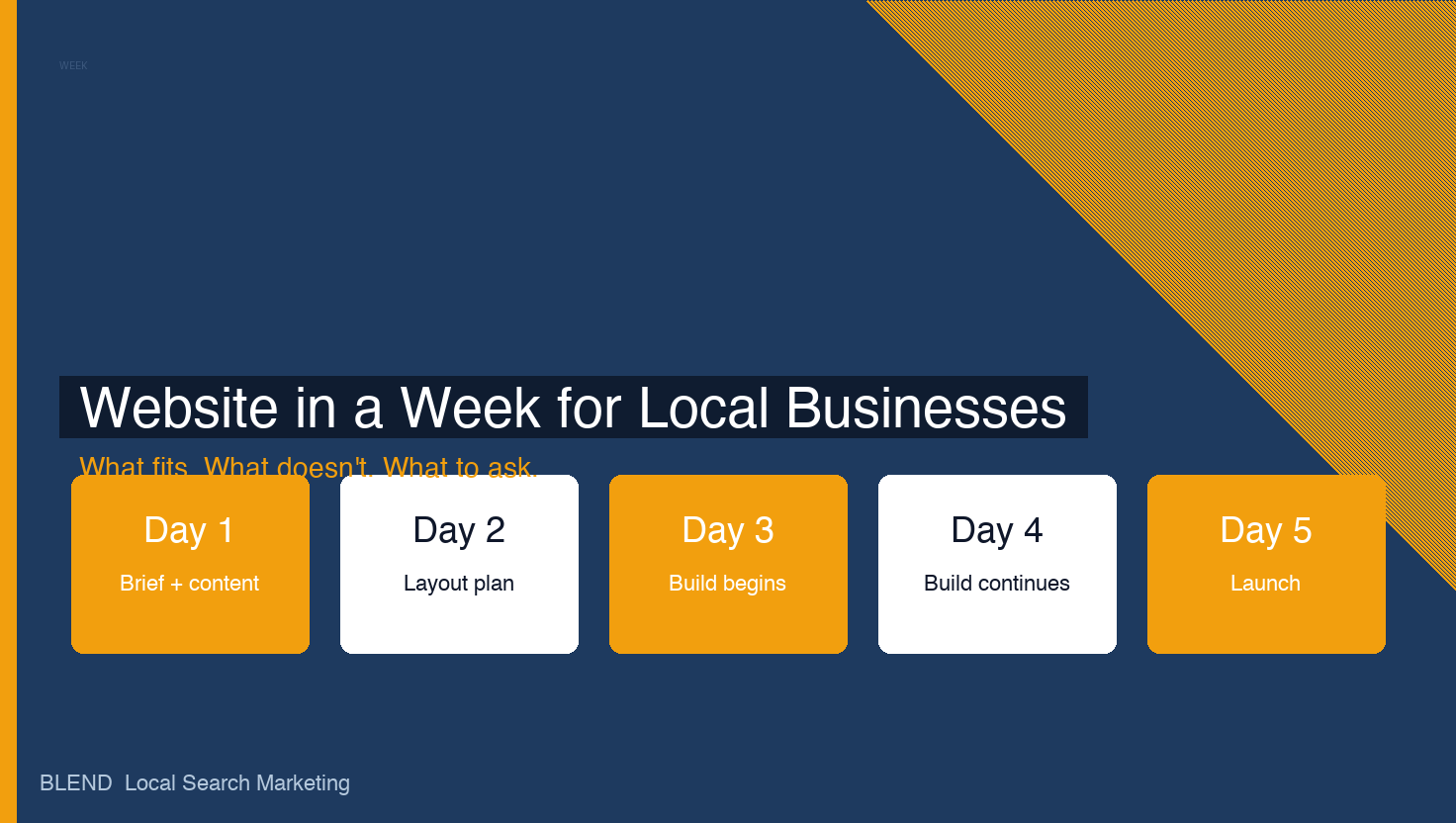
- Day 1. Brief review, content collection, decisions on services, areas, and call to action.
- Day 2. Wireframe or layout plan, agreed in writing.
- Day 3 and Day 4. Build, including homepage, service pages, about, reviews, contact.
- Day 5. Mobile test, speed test, form test, tracking check, launch.
A sprint that runs longer than a week has usually hit one of three problems: the brief was not clear, the content was not ready, or the scope quietly grew beyond what fits in five days. None of those problems are disasters. All of them are easier to manage when they are named up front.
How a website sprint fits into local visibility, not just design
A website that looks good but cannot be found is a wasted sprint. A useful sprint includes the local SEO foundations that make the new site work for Google, Google Maps, and AI-shaped search. Google's own local ranking guidance still centres around relevance, distance, and prominence, which is why these foundations matter as much as the design work (Google Search Central documentation).
- Service area pages for each main location or region.
- A consistent NAP, name, address, phone, across the site and the Google Business Profile.
- LocalBusiness schema that describes the business accurately.
- Internal links from service pages to relevant location pages.
- A clean URL structure that makes sense to a human and to a search engine.
- An FAQ block on each service page that answers the questions real customers ask.
These are not extras. They are the difference between a site that produces enquiries and a site that produces silence. Our Local SEO Services hub explains how the website fits into the wider local visibility work, and most website sprints include these foundations as standard.
What this looks like in a real campaign
A decent example. A local plumbing business came to us with a five-year-old website, no service pages, and a Google Business Profile that was bringing in views but no calls. The website had a homepage, an about page, a single services page, and a contact form that had not been tested in over a year.
The brief was clear: replace the site with a sharp, fast, mobile-first build that makes the next step obvious, add proper service pages for the four main jobs the business takes on, add a tap to call button, fix the form, and align the copy with the GBP.
The build ran over five working days. Two rounds of revisions in the first two weeks after launch. A clean handover with the business owning the platform, the login details, and the analytics. Six weeks after launch, the business was getting more enquiries from the website than from any other channel, including the GBP.
The point is not the specific result. The point is what made the result possible. A clear brief. Ready content. Honest scope. A focused sprint. Local SEO foundations included. The business owning the site at the end. None of that is exotic, and none of it requires a six-month project.
DIY, hire a freelancer, or run a sprint
Three realistic options for a local business that needs a new website. Each has a place.
DIY on a modern platform
Worth doing if the business owner is comfortable editing pages, has the time, and the brief is simple. Tools like WordPress, Squarespace, and Wix have moved on. A competent DIY build can produce a usable site, and many local businesses do. The risk is that the site drifts out of date, the basics get skipped, and there is no one accountable for the result.
Freelance designer or small studio
Worth doing if the business wants a custom design and has the time to manage the project. The risk is scope creep, missed deadlines, and a finished site that looks good but does not convert. The upside is more creative input and a closer working relationship than a large agency.
Focused sprint with a local SEO specialist
Worth doing if the business wants a fast build that includes the local SEO foundations and a clear conversion focus from day one. A sprint is not right for businesses that want a heavily bespoke design or a complex feature set. It is right for businesses that need a sharp, conversion-focused replacement for an outdated or missing site, with the basics done properly.
Common mistakes when buying a website in a week
A few patterns we see often. Worth avoiding.
- Buying a template dressed as a custom build. Most "website in a week" offers are template builds with the business colours swapped in. Templates are fine if used well, but they should not be sold as custom design.
- Skipping the brief. A sprint without a clear brief is a sprint that wastes time and produces a vague site.
- Letting the agency keep ownership of the site. The site should be on a platform the business owns, with login details handed over at launch.
- Skipping the tracking. A new site without call tracking, form tracking, and analytics is a black box. The business cannot tell whether it is working.
- Skipping the local SEO foundations. A pretty site that cannot be found in Google or Google Maps is a wasted opportunity.
- Ignoring the post-launch period. Most websites need at least one round of revisions in the first month, plus ongoing small updates. A sprint that ends at launch is not finished.
Local business website sprint checklist
Use this list when scoping any fast build, whether you use Blend or another provider. If the answer to most of these is unclear, the sprint will be unclear.
- Is the brief in writing, with the number of pages, the list of services, and the call to action agreed up front?
- Is the copy written or reviewed by a human, not generated by AI without review?
- Are photos, logos, and reviews ready before the build starts?
- Is the site built on a platform the business will own and be able to edit?
- Is mobile tested first, not adapted from a desktop design?
- Are service pages proper pages, not paragraphs on a single services page?
- Are trust signals visible above the fold on the homepage and the service pages?
- Is the phone number a tap to call link on mobile?
- Is the enquiry form five fields or fewer, and has it been tested?
- Is LocalBusiness schema included, and has it been validated?
- Are service area pages included for the locations the business serves?
- Is call tracking, form tracking, and Google Analytics 4 set up before launch?
- Has the site been submitted to Google Search Console with a sitemap?
- Is post-launch support included, and for how long?
- Are the login details handed over at launch, not held by the agency?
If the sprint passes that list, the business is in a strong position. If it fails more than two or three, the business is paying for a fast website and getting a slow disappointment.
Recommended next step
If your current website is costing you enquiries and you are weighing up a fast build, the fastest way to get a useful answer is to spend an hour on the conversion checklist from the previous post in this series. If most answers are no, the problem is structural, and a focused sprint will almost certainly be faster and cheaper than patching the old site.
Request a Local Business Website Sprint review with Blend and we will tell you honestly whether a sprint is the right move for your business, or whether a smaller fix is enough.
If the bigger issue is that the site is not producing enquiries because no one is finding it, the right starting point is our Website Conversion Audit, which goes through the site, the GBP, and the wider local visibility picture in a single engagement.
FAQs
Is a website in a week realistic for a local business?
Yes, when the brief is clear, the content is ready, and the goal is a sharp, conversion-focused replacement for an outdated or missing site. No, when the business still needs help defining its services, its offer, or its positioning, because strategy work takes longer than the build itself.
What is the difference between a website sprint and a normal website project?
A normal project usually includes brand strategy, design exploration, custom photography, and a longer build timeline. A sprint assumes the strategy is already agreed and focuses the week on build, copy, and launch. The trade-off is less creative exploration in exchange for a faster, cheaper, more focused result.
What can a one-week website sprint realistically deliver?
A homepage, three to five proper service pages, an about page, a reviews or testimonials page, a contact page, basic local SEO foundations, mobile-first design, clean tracking setup, and a launch with the business owning the site at the end.
What should not be in a one-week sprint?
Brand strategy, custom photography, a full visual identity project, custom web applications, large e-commerce builds, and the migration of complex legacy systems. None of those fit, and any provider promising them in a week is either cutting corners or planning to miss the deadline.
How much does a local business website sprint cost?
The honest range for a focused sprint is wide. Less than a thousand pounds usually means a template build with minimal included scope. Several thousand pounds usually means a real sprint with proper copy, real service pages, and the local SEO foundations included. If the price is well outside that range, ask what is included and what is not.
Do I own the website after a sprint?
You should. The site should be on a platform you control, with the login details handed over at launch. If the agency holds the domain, the hosting, or the platform account, you do not really own the site.
Is local SEO included in a website sprint?
It should be. Basic local SEO foundations, including service area pages, consistent NAP, LocalBusiness schema, internal links, and a clean URL structure, are part of any honest sprint for a local business. They should not be a separate fee.
How do I know if I need a sprint or just a few conversion fixes?
If the website is on a modern platform and the main issues are missing tap to call buttons, a long form, and thin service pages, a few conversion fixes are enough. If the site is on an outdated platform, the structure is wrong, or the basics have been skipped for years, a sprint is usually faster and cheaper than patching.
Disclaimer
This article is general marketing advice for local businesses and does not constitute legal, financial, or technical certification. Sprint scope, pricing, and timelines vary by sector, location, and the current state of your website, content, and tracking setup. The campaign example used in this guide is an illustrative pattern drawn from real client work and has been generalised to protect client confidentiality.