Why Local SEO Is Becoming Local Visibility Engineering
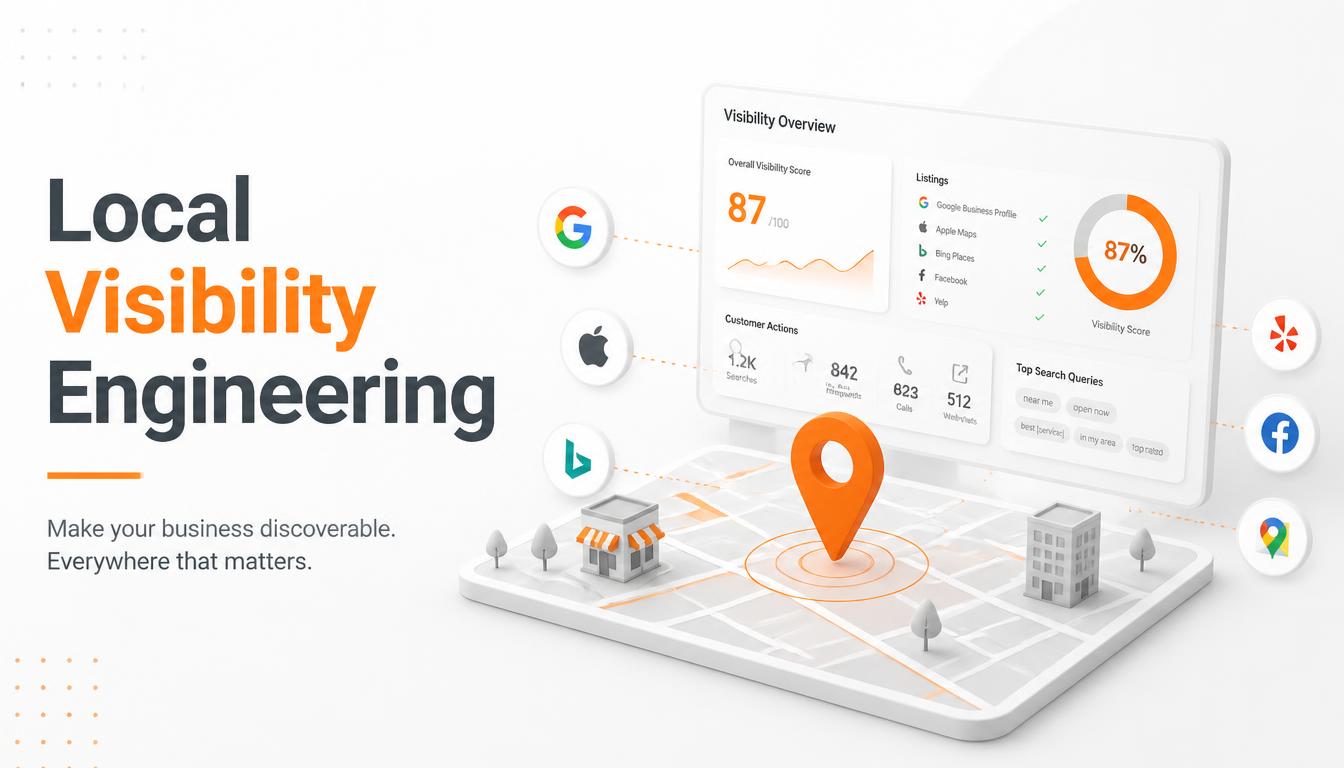
Local SEO is changing faster than most small business owners realise. For years, the playbook was straightforward: build citations, earn reviews, chase backlinks, and hope Google puts you in the local pack. It still works — partially — but the game has shifted beneath our feet.
AI search tools, Google's own generative features, and the fragmentation of where customers actually look for local businesses have turned what used to be a marketing discipline into something much more technical and much more systematic. We are not just doing local SEO anymore. We are engineering local visibility.
TL;DR
Local SEO has evolved into local visibility engineering — a coordinated system covering Google Business Profile, website structure, review signals, conversion tracking, and AI search readiness. It is no longer about one tactic. It is about every touchpoint working together so a business is findable, credible, and easy to contact wherever a customer searches.
The reason I use the word engineering is intentional. Engineers do not guess. They design systems with clear inputs, defined processes, and measurable outputs. That is what effective local visibility looks like today.
A business owner does not need to understand the engineering. They need to know that when someone searches for their service, they show up — across Google Search, Google Maps, AI tools, and review platforms — and that every touchpoint pushes the customer toward making contact.
What changed
Five shifts are driving this change:
1. AI search is a new channel, not a novelty
ChatGPT, Perplexity, Gemini, and Copilot now process tens of millions of searches per month. A significant and growing share of those are local — "best plumber near me", "dentist who takes NHS patients", "accountant in Manchester." These tools do not return ranked links. They return a generated answer that either includes the business or does not. If a business's online presence is not structured to be cited, it is invisible there.
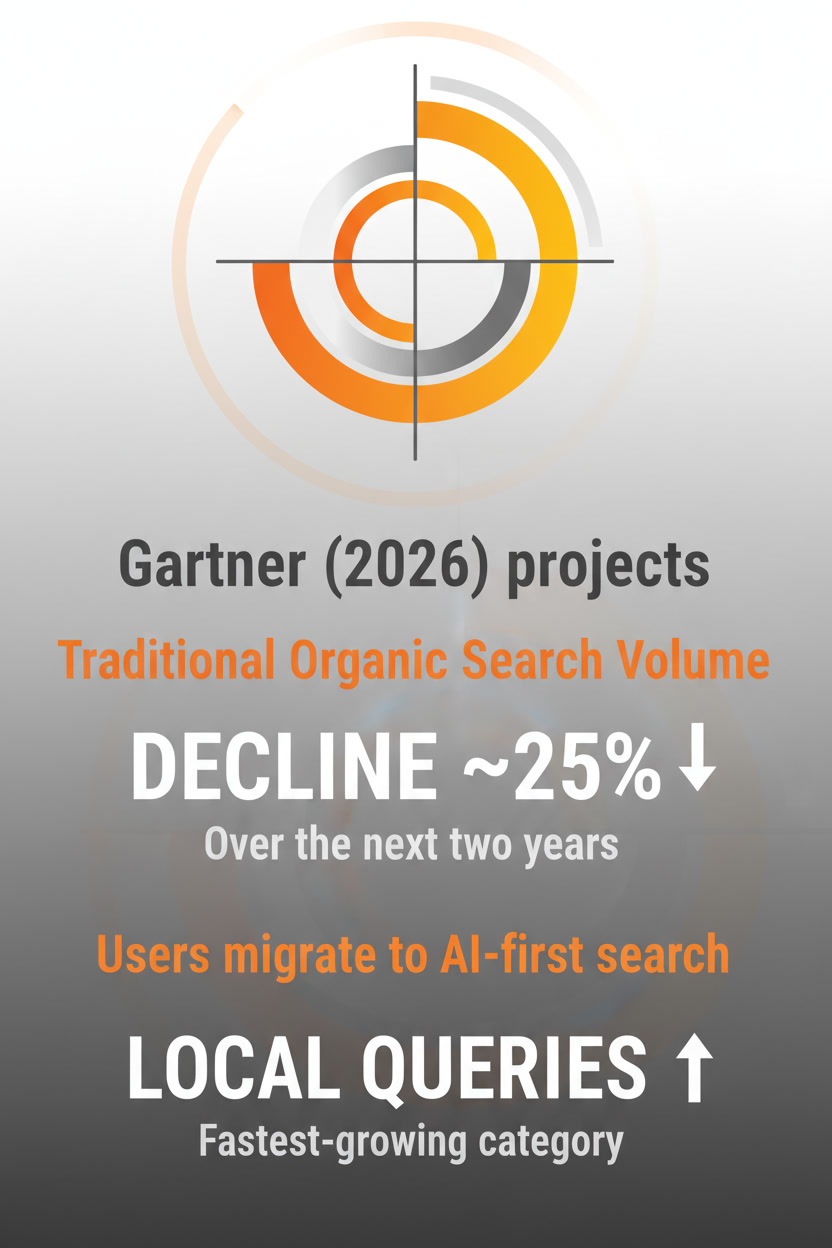
This is not speculative. Gartner (2026) projects that traditional organic search volume will decline by approximately 25% over the next two years as users migrate to AI-first search interfaces. Local queries are among the fastest-growing categories.
2. Google's own search results are changing
Google's Search Generative Experience, AI Overviews, and the increasing prominence of "People Also Ask" and rich features mean the traditional ten blue links are no longer the entire story. Even when a business ranks number one organically, the customer may never click past the AI-generated summary, the map carousel, and the sponsored results above it.
Rankings still matter, but they are only one component of a broader visibility picture.
3. The customer journey is fragmented
A customer might discover a business through Google Maps, research it on ChatGPT, check reviews on Google, then visit the website. Three different platforms. Three different visibility signals. A business that only optimises for one of those will underperform against competitors who are present across all of them.
4. The barrier to doing it right has increased
It used to be possible to rank well with minimal effort and incomplete information. Not anymore. Google expects complete and accurate business data, active profiles, fresh photos, review signals, structured content, clean tracking, and technical soundness. The work is more complex, and the margin for error is smaller.
5. Visibility without conversion is useless
This is the most important point, and it is one we at Blend have stressed since day one. Getting found is only valuable if it leads to enquiries, bookings, calls, or visits. A beautifully engineered visibility system that does not connect to a converting website or a responsive phone number is just an expensive hobby.
This is why local visibility engineering is not just about being found. It is about being found by the right person, at the right time, in the right context, with a clear path to action.
What local visibility engineering looks like in practice
Let us break down what this actually means. It is not a single thing. It is a set of interconnected components that work together.
Google Business Profile as an active signal, not a formality
A GBP that is set up and forgotten is a liability, not an asset. Effective visibility engineering treats GBP as a living channel — updated with accurate categories, current services, fresh photos, regular posts, and monitored reviews. It is one of the strongest signals in Google's Local Pack algorithm, and it is often the first point of contact for a local customer.
Website structure that supports both search and conversion
A website designed for local visibility engineering has dedicated pages for each service, clear service area information, consistent NAP (name, address, phone) data, local business structured data, fast mobile load times, and prominent contact options. It also connects each GBP service and post to the relevant website page so the signals reinforce each other.
Review systems that build trust and search signals
Reviews affect local rankings and customer decisions simultaneously. A business that passively waits for reviews is leaving visibility on the table. The engineering approach builds systems — automated follow-up requests, structured response templates, and processes for handling negative feedback — that make reviews a consistent asset rather than a random occurrence.
AI search readiness
This is the newer piece that most businesses still overlook. AI search tools need clear, authoritative sources to cite. A business that publishes well-structured content, maintains active and consistent profiles across directories, has clear service descriptions, and demonstrates real-world proof points (case studies, testimonials, press) is far more likely to be surfaced in AI-generated answers.
This is where the AI Search Visibility Audit comes in. It checks whether a business's online presence is easy for AI models to understand, trust, and recommend.
Tracking that connects visibility to real enquiries
Without tracking, you do not know what is working. Local visibility engineering requires call tracking, form attribution, session recording, and regular reporting that ties visibility metrics to actual business outcomes. If you cannot measure that a customer found you through search, then booked an appointment, you are flying blind.
Why "local SEO" as a standalone term is running out of time
The term "local SEO" still works — most people know what it means, and search engines still use it as a framework. But it is becoming an incomplete label because it was designed for a simpler era.
When local SEO meant optimising for Google Maps and organic listings, the scope was narrow. Today, a business needs visibility across traditional search, AI tools, review platforms, social directories, and increasingly, the emerging generative web. Each of these has different ranking factors, different optimisation requirements, and different measurement methods.
The professionals who understand this distinction are already reframing their work. We are not abandoning local SEO. We are expanding it into a wider discipline that encompasses every channel where a local customer might encounter a business before making contact.
If you are comparing local SEO providers and the only thing they mention is "I will improve your local search rankings," ask what else they cover. Ask about AI search, about website conversion, about review systems, about tracking. A provider who only talks about local SEO in the traditional sense may be offering you a service that was sufficient in 2019 but is no longer enough today.
What this means for small businesses
There is good news, and it is not complicated. You do not need to become a technical expert to benefit from this shift. The engineering is the job of someone who understands it. Your job is to know what to look for and what questions to ask.
The questions that matter:
- Does your provider cover Google Business Profile, website, reviews, and tracking — or just one of these?
- Are they thinking about AI search, or only traditional search?
- Can they show you how their work translates into enquiries, not just rankings?
- Do they have a plan for what happens after you get found — i.e. your website and phone system?
- Are they honest about what they can and cannot control?
If the answer to the first question is "yes" to all four areas and the last is "we do not promise page one, we promise more enquiries," you are talking to someone who understands the current landscape.
The practical path forward
For businesses that want to take this more structured approach, the starting point is usually an audit. A good audit looks at every component — GBP, website, reviews, tracking, AI search presence — and tells you what matters, what can wait, and what will move the needle first.
We offer a local SEO audit and a website conversion audit that cover these areas. Either one is a practical starting point for businesses that feel their current visibility is not delivering the enquiries they expected.
Local visibility engineering is not about complexity for complexity's sake. It is about building a system that works consistently, that is measurable, and that turns search interest into real business. The businesses that get this right now will be in a strong position for the years ahead, as search continues to fragment and AI reshapes how customers find local services.
The era of "set it and forget it" local SEO is over. The era of visibility engineering is here.