The Benefits of Competitor Reviews and Review Collections

By Perry Stevens, Blend Local Search Marketing | May 2026
Cracking the Code
Are you tired of feeling like your business is stuck in a rut? Do you feel like you're missing out on potential customers and revenue? The secret to unlocking your business's full potential lies in competitor reviews and review collections. Yes, you heard that right! NOT your reviews, your competitor reviews can give you a competitive edge, improve your online reputation, and increase visibility. And when paired with a review collection, the benefits are endless.
Key Stat: Businesses that actively monitor competitor reviews and respond to customer feedback see 270% higher conversion rates when displaying reviews on their website. Additionally, 94% of consumers say a negative review has convinced them to avoid a business — making review management a critical competitive advantage. (Source: InDataLabs, "Customer Review Sentiment Analysis"; ReviewTrackers, "Online Reviews Statistics", 2025)
TL;DR
- Competitor reviews reveal gaps in the market, customer pain points, and emerging trends your competitors are missing.
- Review collections build trust, improve search visibility, and increase conversion rates by up to 270%.
- Sentiment analysis of reviews helps identify product issues, customer favourites, and trends faster than traditional research.
- Blend Local Search Marketing offers ReviewInsightsPro to automate competitor review monitoring and response.
In this article, we'll show you how to crack the code and unleash the power of competitor reviews and review collections. By analysing sentiment in customer and product reviews, you'll gain valuable insights into product/service issues. You'll identify customer favourites and trends and build trust with potential customers.
So, are you ready to take your business to the next level? Keep reading to find out how!

Think of your competitor reviews as a wealth of consumer insights that hold the key to success for YOUR business. – Perry Stevens
Introducing – Review Insights Pro
 Being in the local marketing space since 2008, we have been in a unique position to see our clients pain points with review management. So we have developed an easy to use app and Chrome extension for effortless review management. With Review Insights Pro, you can easily monitor and respond to customer reviews. You can also boost your online reputation, and gain valuable insights into your brand's perception. It even suggests pre-written responses to save time and respond professionally.
Take control of your online presence and turn reviews into success stories. Ready to experience Review Insights Pro? Sign up for a free trial today and see the difference it can make to your business.
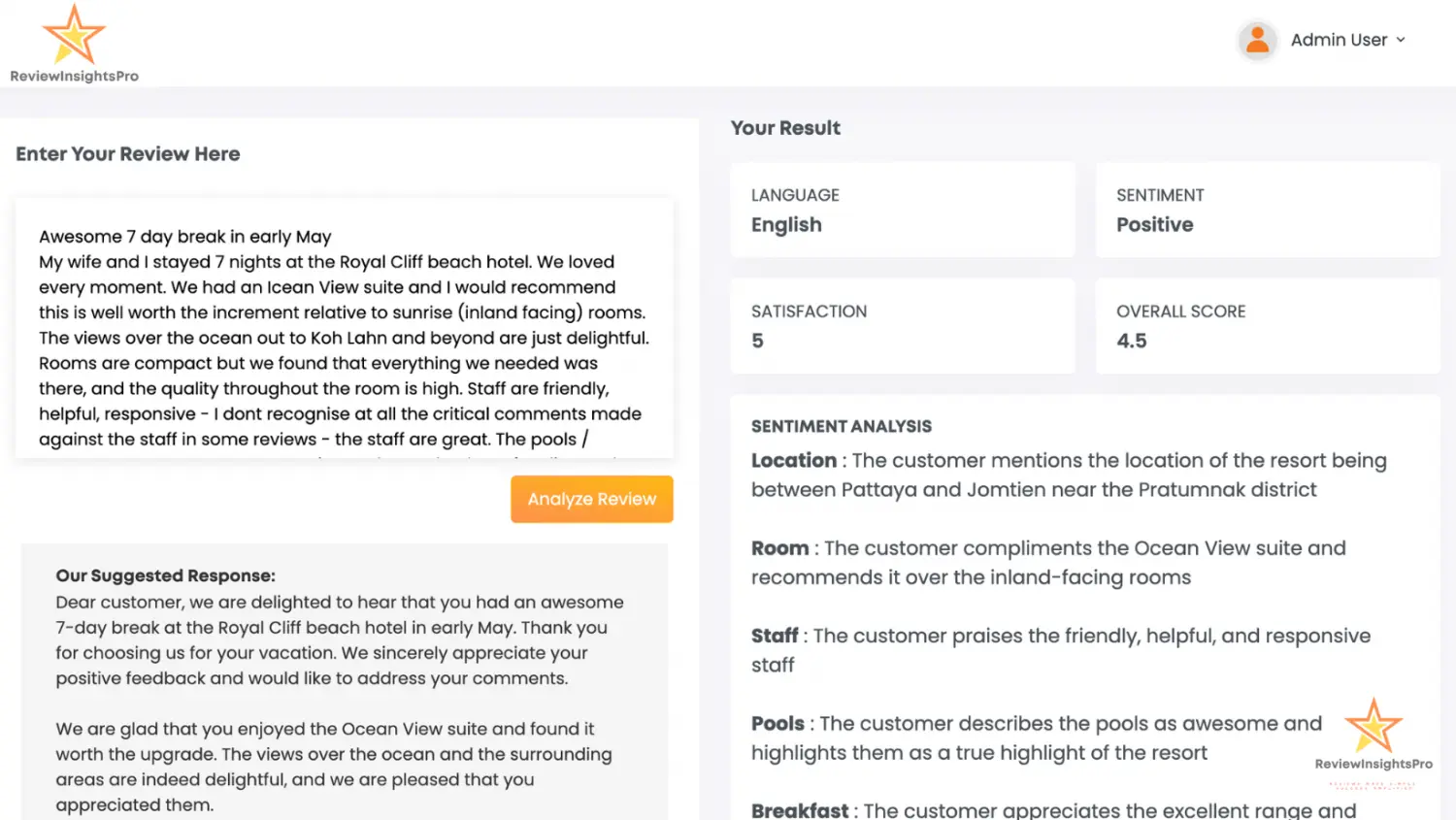
Example of review, sentiment analysis and suggested response by Review Insights Pro.
Understanding Competitor Reviews
As a business owner, it's critical to know what your competitors are doing right (or wrong). This is where competitor reviews come in. Competitor reviews are customer reviews of your competitors' products or services. They can provide valuable insights into what customers like (or don't like) about your competitors, which can help you improve your own offerings.
But why is it so necessary to conduct competitor research? Well, for starters no one is doing it. Secondly it allows you to identify gaps in the market that your business can fill. If your competitors lack in a certain area, you can step in and offer a better solution. Additionally, competitor research can help you stay ahead of the curve. By keeping an eye on what your competitors are doing, you can anticipate trends and adjust your strategy accordingly.
There are several categories of competitor reviews, each presenting their own perspective. First, there are product reviews, which provide insights into your competitors' strengths and weaknesses. Service reviews focus on the customer experience, including customer service and support. Finally, there are industry reviews, which provide a broader view of the market as a whole. By analysing reviews in each of these categories, you can gain a better understanding of your competitors and the market you're operating in.
In short, understanding competitor reviews is the key to unlocking your business's full potential. By conducting thorough competitor research and analysing reviews in various categories, you can stay ahead of the curve. You can identify gaps in the market, and improve your own offerings.
The Importance of Review Collection
I know full well as a business owner it's easy to get caught up in day-to-day operations and forget about the most significant aspect of your business: your customers. That's where the review collection comes in. By collecting reviews from your customers, you can gain valuable insights into what's working and what's not working in your business so you can improve accordingly.
Customer feedback cannot be overemphasised. Not only does it provide you with valuable insights, but it also helps build trust with potential customers. When customers see that you're actively seeking out their feedback and making improvements based on it, they're more likely to trust and choose your business over others.
But review collection benefits don't stop there. By collecting reviews, you can also improve your online reputation. A steady stream of positive reviews can boost your business' credibility and increase search visibility. And even negative reviews can be valuable, as they provide an opportunity to address issues and improve.
So, how do you collect reviews? There are several platforms you can use, depending on your business and industry. Some popular options include Google Reviews, Yelp, and Facebook Reviews. You can also use specialised review collection platforms like BrightLocal, which offer a range of features and tools to help you collect, analyse, and manage reviews.
In short, review collection is a vital part of any successful business. By collecting reviews from your customers and analysing sentiment, you can gain valuable insights, improve your online reputation, and solidify trust with potential customers. So, don't overlook review collection; your business (and your customers) will thank you for it.

Focus on the customer, not the competition. – Brad Dunn
Analysing Customer Feedback
Once you've collected a batch of customer reviews, the next step is to analyse them and extract insights. But how do you analyse review sentiment? There are several techniques you can use, such as sentiment analysis software, manual categorisation, and keyword analysis.
One of the main benefits of analysing customer feedback is identifying product or service issues. By analysing negative reviews, you can pinpoint specific pain points and improve your offering. Additionally, studying reviews can help you identify trends and determine customer favourites. By understanding what your customers love most about your product or service, you can focus on those areas and build your business around them.
But how do you identify these issues and trends? One technique is to categorise reviews manually. This involves reading through each review and assigning it to a specific category (such as "pricing," "customer service," or "product quality"). This can be time-consuming, but it provides a more nuanced view of customer sentiment than automated sentiment analysis.
Another technique is keyword analysis. This involves identifying frequently used words or phrases in customer reviews and using them to identify common themes or issues. For example, if customers frequently mention "slow shipping," you may need to re-evaluate your logistics processes.
In short, analysing customer feedback is a crucial step in understanding your customers and improving your business. By using techniques such as sentiment analysis, manual categorisation, and keyword analysis, you can identify product or service issues. You can also determine customer favourites, and stay ahead of industry trends.
Reputation Management
Your reputation precedes you and your online reputation can make or break your business. That's why it's imperative to actively manage it, and customer reviews can be a powerful tool in this regard. By encouraging satisfied customers to leave positive reviews, you can improve your online reputation and attract new customers.
One way to improve your online reputation is to display seller ratings and stars in Google SERPs. This gives potential customers a quick and easy way to gauge your business's quality, and can increase click-through rates to your website. Additionally, having a high seller rating can help you edge out the competition and increase your visibility in search results.
But it's not just about quantity; it's also about quality. By responding to negative reviews in a timely and professional manner, you can show potential customers that you take their concerns seriously. You commit to excellent customer service.
Another key aspect of reputation management is ensuring that your business is listed on relevant review platforms. This not only provides another avenue for customers to leave reviews, but it also helps potential customers find your business when conducting research. Popular review platforms include Bing, Yelp, and Google Business Profile.
In short, reputation management is a vital part of any business strategy, and customer reviews can be a valuable tool for improving your online reputation. By displaying seller ratings and stars in Google SERPs, responding to negative reviews, and ensuring your business is listed on relevant review platforms, you can increase your visibility, solidify trust in your brand image, and encourage click-through rates from potential customers.

Understanding how competitors are dealing with market dynamics is crucial for laying the ground for any new business, product launch, or key decision in a company's strategy. – Datarade
Trust and Click-Through Rates
As a business owner, building trust with potential customers is crucial to your success. One way to do this is by leveraging user-generated content in the form of customer reviews. By showcasing real customers' experiences, you can provide social proof that your products or services are worth investing in.
But it's not just about building trust; customer reviews can also encourage click-through rates and attract potential customers. When someone considers a purchase, they often conduct research to learn more about the product or service. By having a strong presence on review platforms and displaying seller ratings and stars in Google SERPs, you can increase your visibility and attract more potential customers.
Of course, it's worthwhile to remember that not all reviews will be positive. But even negative reviews can be an opportunity to build trust with potential customers. By responding to negative reviews in a professional and empathetic manner, you can show that you care about your customers. You commit to excellent customer service.
It's also worth noting that customer reviews can help you overcome self-limiting beliefs. As a business owner, you may sometimes have doubts about your products or services. But by seeing positive reviews from satisfied customers, you can gain confidence in your business and improve where necessary.
In short, building trust through user-generated content in the form of positive reviews is essential for attracting potential customers and increasing click-through rates. By responding to negative reviews, leveraging review platforms, and embracing customer feedback, you can solidify trust in your brand image and overcome self-limiting beliefs.
Conversion and Revenue
Customer reviews not only build trust and attract potential customers, but also directly impact conversion rates and revenue. Studies show that displaying reviews on your website can increase conversion rates by up to huge 270 percent.
So how can you leverage reviews to increase conversions and revenue? First, by asking for them. Then strategically placing reviews on your website and marketing materials. For example, you could include customer testimonials on your product pages, contact page, share on social networks or highlight seller ratings and stars in your Google Shopping ads.
Another way to use reviews to increase conversions and revenue is by addressing common customer concerns or objections. For example, if customers frequently express concerns about your product's durability, you could highlight positive reviews that speak to the product's longevity.
Innovative businesses are also finding effective and creative ways to use reviews to increase conversions and revenue. For example, some companies use customer reviews to create product comparison tools or personalised product recommendations based on customer review history.
Reviews directly impact your bottom line by increasing conversion rates and revenue. By strategically placing reviews and using them to address customer concerns, you can further leverage competitor reviews and review collections to grow your business.
Final Thoughts
Analysing sentiment in customer and product reviews is essential to any successful business strategy. By conducting competitor research, collecting reviews, and analysing customer feedback, you can gain valuable insights into your customers' needs and preferences. This will improve your online reputation, and increase conversion rates and revenue.
However, it's worthwhile to remember that not all reviews are created equal. Shortlisting the right reviews for analysis is crucial to accurate and useful insights.
Reviews of business solutions require innovation and creativity. From personalised recommendations to product comparison tools, reviews offer endless opportunities to grow your business.
So if you're looking for ways to gain a competitive edge, consider competitor reviews and review collections. By harnessing customer feedback, you can solidify trust, improve visibility, and ultimately drive conversions and revenue for your business.

Performing sentiment analysis using product review data takes resources and dedication, but the results often pay off. One of the primary reasons to evaluate content this way is that it allows marketers to identify changes in people's feelings sooner than they otherwise might – InDataLabs
About the Author
Perry Stevens is the founder of Blend Local Search Marketing, a Singapore-based agency that helps local businesses turn reviews into revenue through review monitoring, sentiment analysis, and reputation management. With over 15 years in digital marketing, he created ReviewInsightsPro — an AI-powered app that monitors reviews, analyses sentiment, and suggests professional responses for busy business owners.
FAQ
How do I perform a data-driven competitor analysis?
Data-driven competitor analysis should start with identifying the key questions your business needs to answer. Once the task is clearly defined, use tools like ReviewInsightsPro, Trustpilot Insights, or manual review mining to gather data points. Analyse competitor reviews by category (product, service, industry) to identify gaps, trends, and opportunities your business can exploit.
Why is competitor analysis so crucial?
Understanding how competitors deal with market dynamics is crucial for laying the groundwork for any upcoming business, product launch, or key decision in a company's strategy. A well-executed data-driven competitive analysis gives companies plenty of quantitative and qualitative data to back their business decisions — and most businesses never do it, giving you an immediate edge.
What is Review Insights?
Review Insights is a tool developed by Trustpilot to help businesses uncover consumer insights. However, ReviewInsightsPro (by Blend Local Search Marketing) goes further — it monitors reviews across multiple platforms, analyses sentiment with AI, and suggests pre-written responses so you can manage your reputation in minutes per day, not hours.
What are the benefits of product review sentiment analysis?
Performing sentiment analysis using product review data allows marketers to identify changes in people's feelings sooner than they otherwise might. This can help businesses stay on top of those changes and improve accordingly. One study found that sentiment analysis revealed the minimum star rating a business should have before people choose it: most people want no fewer than four stars.
How do I conduct a competitive analysis?
Competitive analysis involves researching major competitors to gain insight into their products, sales, and marketing. It can be done by identifying competitors, gathering information about them, analysing their strengths and weaknesses, and identifying opportunities and threats. Start with their reviews — they are a goldmine of unfiltered customer opinion.
Where Do I Go From Here?
Are you a local business owner or an Amazon/Etsy merchant looking to benefit from competitor reviews and review collections? Don't know where to start or how to make the most of customer feedback? Look no further!
Contact Blend Local Search Marketing for expert help with review acquisition, analysis, and proven strategies to gain competitor insights and increase website conversions. Our team of experienced professionals can help you turn reviews into valuable insights and actionable strategies to take your business to the next level.
Don't wait anymore, contact us today to get started!
Want to grow your business?
Turn customer feedback into competitive advantage with our review analysis and strategy services.
Book a Free Consultation