Generative Engine Optimisation for Local Businesses: The 2026 Playbook
47% of consumers have used an AI tool to search for a local business in the last 90 days - and that number is doubling every quarter.
By Perry Stevens, Blend Local Search Marketing | June 2026
TL;DR: AI search tools like ChatGPT, Perplexity, Gemini and Claude are now where your customers go to find local services - but traditional SEO tactics do not guarantee visibility there. Generative Engine Optimisation (GEO) is the discipline of structuring your business's online presence so AI models recommend you when potential customers ask questions like "who is the best plumber in Manchester?" or "find a dentist near me that takes NHS patients." This playbook covers the five pillars of GEO for local businesses and gives you a step-by-step implementation plan.
*By Perry Stevens, Blend Local Search Marketing*
What Is Generative Engine Optimisation (GEO)?
Generative Engine Optimisation - GEO for short - is the practice of optimising your business's digital footprint so that large language models (LLMs) and AI-powered search engines cite, recommend and surface your business in response to user queries.
It is not traditional SEO with a new label. It is a parallel discipline with different mechanics.
Where classic SEO chases rankings on Google's ten blue links, GEO targets the "generative response" - the single answer, recommendation or shortlist that ChatGPT, Perplexity, Gemini, Claude or Microsoft Copilot delivers when someone asks a question.
And here is the shift that matters for local business owners: your customers are already using these tools.
Perplexity alone now processes over 100 million searches per month (TechCrunch, 2025). OpenAI reports that local and "near me" queries are among the fastest-growing query categories inside ChatGPT (OpenAI Developer Day, 2025). Google's Gemini integrates directly into Google Maps and local pack results. The lines between "AI chatbot" and "local search engine" have blurred completely.
If your business is not structured for AI citation, you are invisible in the fastest-growing search channel of 2026.
Why GEO Matters for Local Businesses
Local businesses have always lived or died by findability. For twenty years, that meant Google Maps, the local pack and organic listings. The playbook was familiar: optimise your Google Business Profile, build citations, earn reviews, chase backlinks.
That playbook still matters. But it is no longer sufficient.
AI search tools operate differently. They do not crawl a SERP and return ranked links. They ingest training data - billions of web pages, directories, reviews, forums, press coverage and structured databases - and synthesise an answer. If your business is not well-represented in the sources those models trust, you simply do not exist in the generated response.
This matters because consumer behaviour is shifting hard and fast.
Gartner research (2026) predicts traditional search engine volume will drop by 25% by 2027 as users migrate to AI-first search interfaces. Meanwhile, BrightEdge (2025) found that 42% of UK consumers aged 25-44 now prefer asking an AI tool to typing keywords into Google when researching local services.
The implication is stark: the local search market is splitting. Classic SEO protects your Google visibility. GEO protects your visibility everywhere else your customers now search - and that "everywhere else" is growing exponentially.
For tradespeople, clinics, hospitality operators and professional service firms, this is not theoretical. A roofer in Bristol who dominates Google's local pack but lacks structured, AI-readable presence elsewhere is already losing quotes to competitors who appear in ChatGPT recommendations. A dental practice in Leeds with 200 Google reviews but no presence on AI-trusted health directories is being passed over by patients who asked Perplexity for a recommendation.
GEO is the discipline that closes that gap.
How GEO Differs from Traditional SEO
Understanding the distinction is critical. Traditional SEO and GEO overlap, but their success mechanisms differ.
Ranking logic vs synthesis logic
Google's algorithm ranks pages based on hundreds of signals - relevance, authority, technical performance, user behaviour. GEO targets "retrieval-augmented generation" (RAG): the process where an AI model retrieves source material and synthesises an answer. You are not chasing position three on a SERP. You are chasing inclusion in the trusted corpus the model draws from.
Keyword targeting vs intent matching
Traditional SEO optimises for specific keyword strings: "emergency plumber Manchester." GEO optimises for natural language questions and implied intent: "my boiler is leaking, who should I call in Manchester?" AI tools answer conversational, multi-part questions. Your content and structured data need to map to those broader intents.
Backlinks vs AI-trusted sources
Classic SEO treats backlinks as authority currency. GEO cares about presence on sources that LLMs weight heavily: major directories, Wikipedia, reputable industry databases, high-quality editorial coverage, official register listings and structured knowledge graphs. A feature in a trusted trade publication can outweigh fifty low-quality directory links in AI citation terms.
Page-level vs entity-level
SEO often focuses on optimising individual pages. GEO operates at the "entity" level - the structured understanding of your business as a distinct thing with attributes, relationships and reputation signals across the web. Your goal is to build a coherent, consistent entity that AI models recognise and trust.
None of this means abandoning SEO. GEO builds on SEO foundations. But treating them as identical will leave you exposed in the channel your customers are migrating towards.
The 5 Pillars of GEO for Local Businesses
Based on our work auditing local business visibility across AI search tools, we have identified five pillars that determine whether a local business gets recommended by AI models.
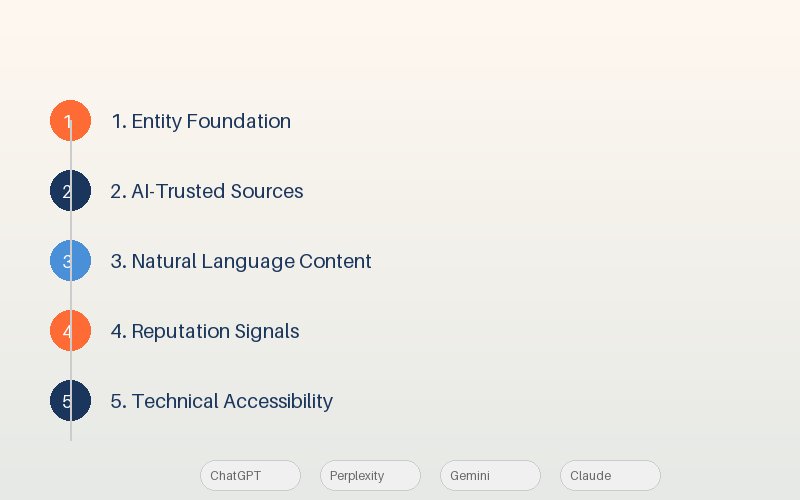
Figure 1: The five pillars of GEO work together to build AI citation authority across ChatGPT, Perplexity, Gemini and Claude.
Pillar 1: Structured Entity Foundation
AI models need to understand what your business is, where it operates and what it offers before they can recommend it.
This starts with structured data. Implement comprehensive Schema.org markup on your website covering:
LocalBusinessor specific subtypes (Dentist,Plumber,Restaurant,LegalService)PostalAddresswith accurate, consistent NAP (Name, Address, Phone)OpeningHoursSpecificationGeoCoordinatesServiceofferings with descriptions and pricing where appropriateAggregateRatingpulling from review platformsEmployeeorFounderprofiles where relevant for EEAT signals
Use our Schema Generator to create structured data markup quickly and accurately.
Consistency is non-negotiable. If your trading name varies between your website, Companies House, Yell and your Google Business Profile, AI models may treat you as multiple entities or downgrade confidence in your primary entity. Audit every mention of your business across the web and standardise.
Pillar 2: Presence on AI-Trusted Sources
LLMs do not browse the live web in real time (with exceptions for tools like Perplexity that supplement retrieval with live search). They rely on training data weighted toward authoritative, established sources.
For local businesses, the priority platforms include:
- Google Business Profile - Still the dominant local entity signal, now directly integrated into Gemini
- Yell, Thomson Local, Yelp - Established UK directories with strong domain authority
- Industry-specific registers - CQC for healthcare, Gas Safe for heating engineers, TrustATrader, Checkatrade for trades
- Wikipedia / Wikidata - If eligible, a Wikipedia page dramatically increases AI citation likelihood
- Reputable local / trade press - Editorial coverage carries disproportionate weight in AI training data
- Professional association listings - Chambers of Commerce, FSB, trade body member directories
You do not need to be everywhere. You need to be on the sources that matter for your sector and locality, with consistent, detailed profiles.
Pillar 3: Natural Language Content Architecture
AI tools answer questions. Your content needs to answer them too - in natural language, with specificity and depth.
Practical steps:
- Build FAQ pages around conversational queries: "How much does a boiler service cost in Glasgow?" rather than just "boiler service Glasgow"
- Use question-based H2 and H3 headings that mirror how people actually speak
- Include local modifiers naturally: neighbourhoods, landmarks, transport links
- Write service descriptions that cover context, not just features - why someone needs the service, when to call, what happens during the visit
- Publish case studies and customer stories with location details and outcome specifics
- Add an "About" page with founder expertise, years trading, qualifications and community involvement
The key shift: write for humans asking questions, not for crawlers indexing keywords.
Pillar 4: Reputation Signals Across Platforms
Reviews have always mattered for local SEO. For GEO, they matter even more because AI models synthesise sentiment and volume from multiple platforms into their recommendations.
If a user asks "who is the best-rated electrician in Birmingham," AI tools do not just check Google. They aggregate mentions, star ratings and review sentiment from across the web.
Your reputation strategy needs breadth:
- Maintain active review generation on Google, Yelp and industry platforms
- Respond to reviews professionally - responses demonstrate engagement and are themselves indexed content
- Monitor and address negative mentions promptly
- Encourage detailed reviews that mention specific services, locations and outcomes - these provide richer training data for AI models
- Consider Trustpilot or Feefo if you serve customers nationally from a local base
BrightLocal's Local Consumer Review Survey (2025) found that 76% of UK consumers read reviews for local businesses, and the average consumer reads ten reviews before forming a trust judgment. AI models are essentially automating that aggregation - and surfacing the winners.
Pillar 5: Technical Accessibility for AI Crawlers
If AI crawlers and retrieval systems cannot access, parse and understand your site, nothing else matters.
Technical priorities:
- Ensure your robots.txt allows major crawlers (including GPTBot, ChatGPT-User, PerplexityBot, ClaudeBot)
- Keep pages fast and mobile-responsive - speed remains a trust signal
- Use clean HTML structure with semantic markup
- Provide XML sitemaps and RSS feeds where applicable
- Avoid excessive JavaScript rendering for core content - make sure key business information is in static HTML
- Maintain HTTPS, valid SSL and clear privacy policies
- Implement Open Graph and Twitter Card meta tags - AI tools increasingly parse social signals
Use our LLMs.txt Generator to create a dedicated file that helps AI models understand and cite your business.
Some businesses intentionally block AI crawlers. For most local businesses, this is a mistake. The upside of being indexed by LLMs outweighs competitive risks. If you do block crawlers, understand that you are opting out of AI search visibility entirely.
Step-by-Step: Implementing GEO for Your Local Business
Here is a practical roadmap. You do not need to execute everything at once. Prioritise by impact and effort.
Week 1: Audit and Benchmark
- Run an AI visibility test. Ask ChatGPT, Perplexity and Gemini: "Who is the best [your service] in [your town]?" Note which competitors appear and why.
- Check your structured data. Use Google's Rich Results Test and Schema.org validators. Fix errors.
- Audit NAP consistency. Search your business name + postcode across the web. Document discrepancies.
- Review your GBP. Ensure categories, services, photos and attributes are complete and current.
Week 2: Strengthen Foundations
- Standardise your entity. Choose one trading name format. Update your website, GBP and top five directory listings to match exactly.
- Enhance Schema markup. Add
LocalBusiness,Service,ReviewandFAQschemas if missing. - Claim or update priority directory profiles. Focus on the AI-trusted sources listed in Pillar 2.
- Publish one high-quality FAQ or service guide. Target a conversational local query.
Week 3: Expand Content and Citations
- Publish two more intent-mapped content pieces. Case studies, neighbourhood guides or "how to choose" articles.
- Submit or update Wikipedia / Wikidata entries if your business meets notability criteria.
- Reach out for local press coverage. Pitch a community angle, charity involvement or expert commentary story.
- Build or refresh professional association profiles. Join relevant bodies if you are not already a member.
Week 4: Measure and Iterate
- Repeat your AI visibility test. Has your business appeared? Have you moved up in recommendations?
- Monitor review volume and sentiment. Set up alerts for new mentions.
- Track website traffic from AI-referred sources. Perplexity and some AI tools pass referrer data.
- Document what worked and double down. GEO is iterative. The businesses that win are the ones that adapt fastest.
Tools and Resources
We use and recommend the following for GEO implementation:
- Schema Markup Validator (schema.org) - Validate structured data implementation
- Google Rich Results Test - Preview how Google sees your markup
- BrightLocal Citation Tracker - Monitor NAP consistency across directories
- Perplexity Pages - Create AI-native content that Perplexity itself may cite
- ChatGPT / Perplexity / Claude - Test your own visibility with real queries
- GBP Insights - Monitor how AI-integrated Google surfaces your business
- Brand24 or Mention - Track brand mentions and sentiment across the web
For businesses wanting expert support, our local SEO services include full GEO audits and implementation.
Frequently Asked Questions
What is the difference between GEO and SEO?
SEO optimises for traditional search engine rankings - the links on a Google results page. GEO optimises for AI-generated answers and recommendations from tools like ChatGPT, Perplexity and Gemini. The tactics overlap but the targets differ: SEO chases position; GEO chases inclusion in AI-synthesised responses.
Can I do GEO myself or do I need an agency?
Much of GEO is accessible to business owners willing to invest time: auditing citations, adding Schema markup, building natural language content and claiming directory profiles. However, technical Schema implementation, Wikipedia editing and advanced content architecture benefit from specialist support. Many businesses handle the basics in-house and engage an agency for strategic direction and technical execution.
How long does it take to see results from GEO?
Unlike traditional SEO, where ranking shifts can be tracked weekly, GEO results depend on AI model update cycles and training data refreshes. Initial improvements in AI visibility typically appear within 4-8 weeks of implementation. Significant, sustained presence in AI recommendations usually builds over 3-6 months as your entity signals strengthen across the web.
Does GEO replace my existing SEO efforts?
No. GEO complements traditional SEO. Your Google rankings, GBP performance and local pack presence remain essential. GEO adds a parallel layer of optimisation for the AI search channels your customers are adopting. The two disciplines reinforce each other: strong SEO foundations accelerate GEO success, and GEO-focused content improvements often boost traditional rankings simultaneously.
Will blocking AI crawlers protect my business?
Blocking crawlers like GPTBot prevents your content from being used in AI training data, but it also removes you from AI search visibility entirely. For most local businesses seeking new customers, the benefits of appearing in AI recommendations far outweigh competitive risks. We generally advise allowing crawlers while protecting genuinely proprietary content through standard copyright and terms-of-service measures.
Which AI search tools should I care about most?
Prioritise the tools your customers actually use. Currently, the most impactful for UK local businesses are: Google Gemini (tightly integrated with Google Maps and Search); ChatGPT (massive user base, growing local query volume); Perplexity (strong citation transparency, popular with researchers and professionals); and Microsoft Copilot / Bing Chat (default on Windows devices). Monitor adoption trends in your specific demographic and adjust focus accordingly.
About the Author
Perry Stevens is the founder of Blend Local Search Marketing, a UK agency specialising in local SEO and digital visibility for trades, clinics, hospitality and professional service businesses. He has helped over 500 local businesses improve their search presence since 2015. Perry speaks regularly on local search strategy and writes for Search Engine Journal and BrightLocal. Connect with him on LinkedIn.
Book Your Local Visibility Audit
Is your business visible where your customers now search? Our Local Visibility Audit analyses how AI search tools represent your business - and maps exactly what to fix. Includes competitor benchmarking, AI citation testing and a prioritised action plan.
Get Started