AI Search Optimisation for Local Businesses: A Practical Guide
AI Search Optimisation for Local Businesses: A Practical Guide
AI search optimisation for local businesses is no longer a forward-looking exercise. It is happening right now in local search, and the businesses that ignore it will slowly lose visibility to those who understand how AI systems surface local results.
If you run a local business and you have been told that AI search is not your problem yet, that advice is wrong. Studies show that AI Overview results now appear in over 40 percent of local business queries, and organic click-through rates on those queries have dropped by 61 percent. That is not a distant trend. That is what is happening today.
This guide walks you through what AI search optimisation actually means for a local business, what you should fix first, and what can wait.
The quick answer
AI search optimisation for local businesses means making sure your business information is clear, structured, and easy for AI systems to understand when someone asks a question like "best plumber near me" or "where can I get Invisalign in Birmingham." It involves updating your Google Business Profile, adding structured data to your website, writing clear service content, and making sure your reviews and brand signals are strong. According to HubSpot, 19 percent of marketers plan to add SEO for LLM best practices to their strategy in 2025, confirming that this shift is moving from speculation to mainstream planning (HubSpot, 2025).
How AI search has changed local discovery
The way people find local businesses has changed faster than most business owners realise. A decade ago, getting listed in the Google 3-pack and having a decent website was enough. Today, when someone searches for a local service, Google may respond with an AI Overview at the top of the results, a set of map results, and a page of links that most people never scroll past.
Google's own data shows that AI Overview results now appear in a large share of local queries. A 2025 study by Local Falcon found that over 40 percent of local business-related queries delivered AI-generated content. A separate study by Seer Interactive found that organic click-through rates for queries showing AI Overviews dropped from 1.76 percent to just 0.61 percent.
The practical effect is straightforward. If your business is not visible inside those AI-generated answers, you are invisible to a large share of searches. The 3-pack alone will not save you.
What AI search optimisation actually involves
AI search optimisation for local businesses does not mean chasing the latest algorithm trick. It means doing several things systematically so that AI systems have what they need to recommend you.
1. Entity clarity: make sure AI knows who you are
AI systems need to understand your business as a real, physical entity. They need your name, address, phone number, website, hours, and service area to be consistent everywhere they find it. Inconsistent information across your Google Business Profile, your website, and third-party directories confuses both search engines and AI models.
Fix your NAP (name, address, phone) consistency first. Make sure your Google Business Profile matches your website exactly. Make sure your website footer has the same information. This sounds basic, but it is one of the most common gaps we see.
2. Structured data on your website
Structured data is not just for big brands. Schema markup on a local business website tells AI systems explicitly what your business does, where it is located, what hours you keep, and what services you offer.
The most important schema types for local businesses are:
- LocalBusiness (or a more specific type like Dentist, Plumber, Restaurant)
- Service pages with Service schema
- FAQPage schema for answer content
- Review and AggregateRating schema where appropriate
You do not need to be a developer to add this. Many CMS platforms have plugins, and if you use a custom site, the code snippets are published by Google and straightforward to implement. If you are unsure where to start, our AI Search Visibility Audit walks through each of these points and shows where your business currently stands.
3. Service pages that answer real questions
AI models read your website content the same way humans do. If your service pages are thin, generic, or stuffed with keywords, they will not be pulled into AI-generated answers.
For each service you offer, create a page that answers the specific questions a local customer would ask. What problems do you solve? Who do you work with? What areas do you cover? What is the typical process? What should someone expect?
Write in plain English. Do not try to game the system. Write so that both a confused homeowner and an AI model can understand exactly what you do.
4. Review signals that build trust
Reviews are one of the strongest signals for local businesses, and they matter more than ever in an AI-shaped search environment. AI systems use review content to understand how customers experience your business. They factor in review quantity, review recency, review sentiment, and how responsive you are to feedback.
Make sure you have a system for collecting reviews after every job. Respond to reviews professionally. Do not delete negative reviews. Address them honestly. That honesty is what builds trust with both customers and the AI systems that evaluate trust.
5. Your Google Business Profile as a live asset
Your Google Business Profile is still one of the most important local visibility assets you own. Update it regularly. Add photos. Post updates. Fill out every field. Make sure your services and products sections are complete.
A well-maintained GBP gives AI systems a clean, reliable source of information about your business. A neglected one sends the opposite signal.
6. Content that AI can reference
The type of content that AI systems pull into their answers tends to share certain characteristics. It is authoritative, well-structured, answer-focused, and sourced from sites that clearly demonstrate deep knowledge and real-world experience in their field.
For local businesses this means:
- Blog content that answers common local questions
- Guides and how-to pages relevant to your industry
- Local guides or neighbourhood pages if you serve multiple areas
- Clear answers to specific questions your customers ask
Do not write content for AI. Write content that helps real customers, and AI will pick it up naturally.
What most local businesses get wrong
In our work with local businesses across multiple sectors, we see the same mistakes repeatedly.
Treating AI search as separate from local SEO
AI search optimisation is not a different discipline. It is local SEO extended into a new environment. If your Google Business Profile is solid, your website has clear service pages, your reviews are strong, and your content answers real questions, you are already doing 80 percent of what AI search optimisation requires. Our Local SEO Services page covers the core foundation that every local business needs before layering on AI-specific optimisation.
Expecting immediate results
AI search visibility is not something you fix overnight. It is a gradual accumulation of clear signals over weeks and months. Google's AI Overviews alone took more than a year to reach the adoption levels they have now.
Focusing only on Google
AI search is not just Google. ChatGPT, Perplexity, and other AI tools are increasingly used for local discovery. A business that appears in Google AI Overviews may not appear in a Perplexity answer about the same service. That is why entity clarity and broad-spectrum content matter.
Ignoring the website
Some business owners think they can survive on Google Business Profile alone. It will not work long-term. Your website is the hub that AI systems reference. If your website is outdated, slow, or thin on content, you will lose ground to competitors who invest in it.
A practical checklist for local business owners
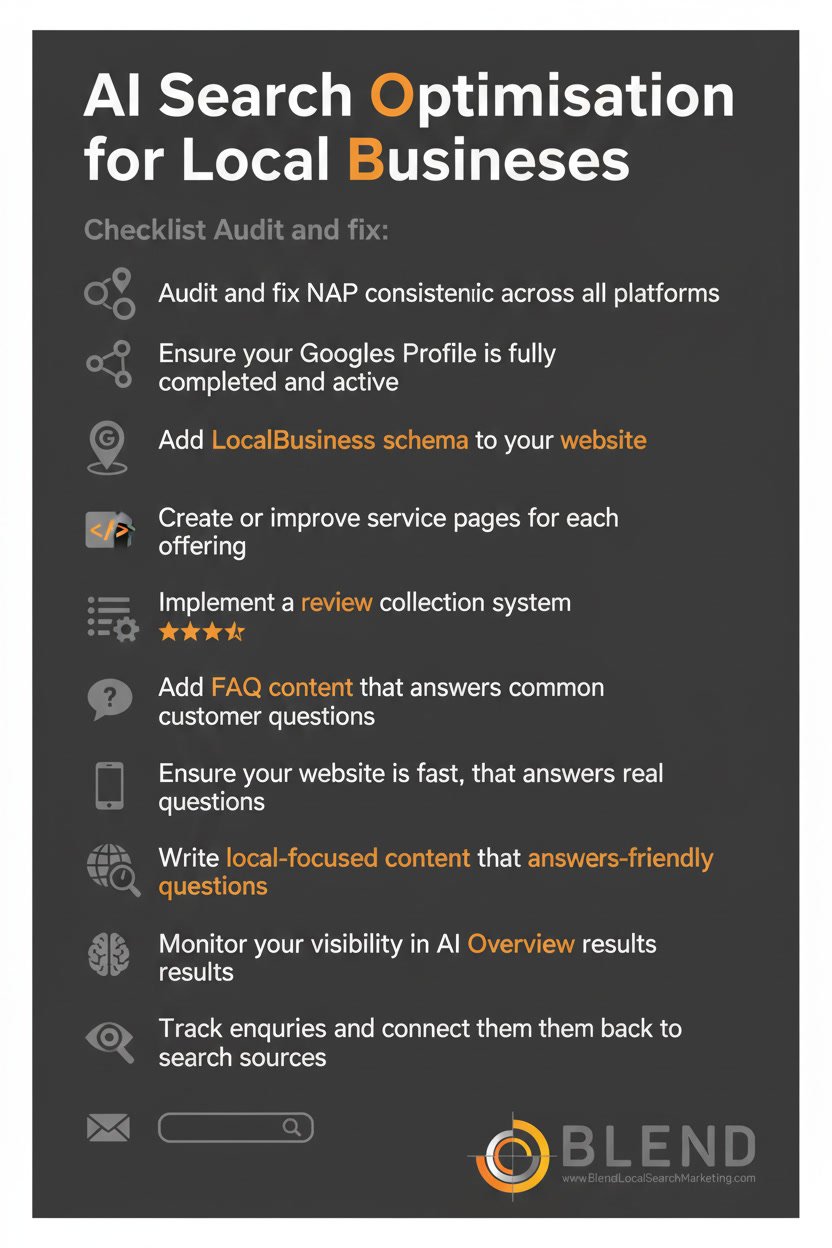
Start with what moves the needle. Here is the order we recommend:
- Audit and fix NAP consistency across all platforms
- Ensure your Google Business Profile is fully completed and active
- Add LocalBusiness schema to your website
- Create or improve service pages for each offering
- Implement a review collection system
- Add FAQ content that answers common customer questions
- Ensure your website is fast and mobile-friendly
- Write local-focused content that answers real questions
- Monitor your visibility in AI Overview results
- Track enquiries and connect them back to search sources
The commercial angle
Here is what most AI SEO guides leave out. AI search optimisation is not an end in itself. The goal is enquiries, not rankings. The goal is more phone calls, more quote requests, more booked appointments.
Every optimisation step should trace back to that outcome. Clearer entity signals mean more appearances in AI answers. Better service pages mean higher conversion when visitors arrive. Stronger reviews mean more trust before someone even picks up the phone.
If you cannot connect an optimisation tactic to a real business outcome, reconsider whether you should be doing it.
FAQ: AI Search Optimisation for Local Businesses
What is AI search optimisation for local businesses?
AI search optimisation for local businesses is the practice of making your business information clear and accessible so that AI systems like Google AI Overviews, ChatGPT, and Perplexity can find and recommend your business when users ask local questions. It combines traditional local SEO with structured data, entity clarity, and answer-focused content.
How is AI search different from regular Google search for local businesses?
Regular Google search shows a mix of map results, listings, and organic links. AI search adds a generated summary at the top of the results that pulls information from multiple sources. If your business is not represented in those AI-generated answers, you lose visibility on a large share of searches. AI search also rewards clear, well-structured content more than keyword matching alone.
Do I need to do something different from regular local SEO?
Most of what you already do for local SEO applies to AI search. A strong Google Business Profile, clean website with service pages, good reviews, and helpful content will serve you well in both environments. The additional work is adding structured data, making your entity information ultra-clear, and writing content in a question-answer format that AI systems can reference.
Will AI search replace the need for local SEO?
No. AI search is a new layer on top of local SEO, not a replacement. In fact, AI search makes solid local SEO more important. AI systems need clear, accurate signals from your business to generate good answers. If your local SEO foundations are weak, AI will not help you. They work together.
How long does it take to see results from AI search optimisation?
Most businesses see incremental changes over 8 to 12 weeks as AI systems recrawl and reindex their content. Some queries may show improvement sooner, while others may take longer. The key is consistency. Update your GBP, publish content regularly, and maintain your review system. Results accumulate over time.
Is AI search optimisation expensive for a local business?
The foundational work is not expensive. Fixing NAP consistency costs nothing. Adding schema markup can be done with free tools or plugins. Writing better service pages is content work, not technology work. The investment is in doing the basics well and consistently, which is what good local SEO has always required.
What we check before giving advice
Every local business is different, and the right mix of optimisation steps depends on where you currently stand. Before we recommend any changes, we check your entity clarity, your website structure, your GBP health, your review signals, and your content coverage across the services and locations that matter to your business.
If you would like a clear picture of where you stand and what to fix first, we offer a Local Visibility Audit that covers all of these areas in one review.
---
This article covers general guidance on AI search optimisation for local businesses. Results will vary depending on your industry, location, and current online presence. Information is current as of 2026. For specific recommendations about your business, consult with a local SEO professional who can review your individual situation.