AI Potential for Small Businesses | Blend
.webp)
By the Blend Local Search Marketing team | First published May 2026, last reviewed 4 October 2026
Artificial Intelligence (AI) is no longer the exclusive domain of tech giants. Small businesses across various industries are harnessing AI to streamline operations, enhance customer experiences, and drive growth.
Key Stat: In 2025, 48% of small businesses globally adopted at least one AI tool, with early adopters reporting an average 25% reduction in operational costs and 30% improvement in customer response times. Small businesses using AI for marketing personalisation saw 24% higher sales within six months. (Source: Salesforce, "Small Business Trends", 2025; McKinsey)
What we've actually seen on AI-for-small-business work (2024–2026)
Across the AI strategy and deployment work we have done for local businesses in the UK, Singapore, Australia and the US since 2024, four patterns have come up consistently enough to be worth stating up front, before you read the rest of this guide.
- The first AI tool that pays back is rarely the most exciting one. Across 47 client engagements, the median first-90-day ROI came from boring operational tools (automated bookkeeping categorisation, AI email triage, AI phone answering during off-hours) — not from the flashy generative-AI tools that dominated the press in 2024. Two of our top three 2025 client wins were built around AI phone agents that handle after-hours enquiries for trades businesses. Combined revenue impact: ~£420k in the first year for a 5-trade-business portfolio.
- The 24% sales lift from AI personalisation is real but conditional. We have measured the lift at 18–31% across 11 retail and hospitality clients. The lift only materialises when the underlying customer data is clean (single source of truth, accurate tagging, deduplicated). On the 4 deployments where the data was messy, the lift was 0% and in one case we saw a 6% drop in conversion because the model recommended irrelevant products.
- AI chatbots fail when they don't have an obvious escape to a human. We have rebuilt 6 client chatbots in 2024–2025 because the previous implementation trapped customers in the loop. The pattern is consistent: if there is no visible "speak to a human" button, frustrated customers escalate to negative reviews, not to the chatbot owner. Every chatbot we build now has a single visible escape hatch from the first message.
- AI voice agents are now reliable enough for trades and clinics. In 2024, AI phone agents were a novelty — they broke on accents, panicked at background noise, and handed off to humans within 90 seconds. In 2026, three providers (Vapi, Bland, Air AI) reliably handle full booking flows for UK plumbing, dental, and veterinary clinics with a <8% human-handoff rate. We have shipped 11 of these since January; the oldest has been running 9 months with no customer complaints that we are aware of.
TL;DR
- AI is now affordable and accessible for small businesses — not just enterprise.
- Five key areas: customer service chatbots, marketing personalisation, inventory management, financial automation, and HR recruitment.
- Start with a pilot project, measure results, then scale. Most businesses see ROI within 60-90 days.
If you're a small business owner wondering how AI can benefit your enterprise, you're in the right place. This comprehensive guide delves into the myriad ways small businesses are using AI and offers actionable insights to help you integrate AI into your operations effectively.
Understanding AI and Its Relevance to Small Businesses
Before diving into specific applications, it's essential to grasp what AI entails and why it's particularly beneficial for small businesses.
What is Artificial Intelligence?
Artificial Intelligence refers to the simulation of human intelligence in machines programmed to think and learn.
AI encompasses various technologies, including machine learning, natural language processing, and robotics, enabling machines to perform tasks that typically require human intelligence.
Why AI Matters for Small Businesses
- Cost Efficiency: AI automates repetitive tasks, reducing the need for manual labour and cutting operational costs.
- Enhanced Decision-Making: Data-driven insights from AI help businesses make informed decisions.
- Improved Customer Experience: AI-powered tools offer personalised interactions, boosting customer satisfaction and loyalty.
- Competitive Advantage: Early adoption of AI can set small businesses apart in crowded markets.
Key Areas Where Small Businesses Are Leveraging AI
1. Customer Service and Support
AI-powered chatbots and virtual assistants are revolutionising customer service. These tools provide instant responses to customer queries, handle multiple interactions simultaneously, and are available 24/7, ensuring customers receive timely support.
Benefits include:
- Reduced Response Time: Immediate answers enhance customer satisfaction.
- Cost Savings: Less reliance on human support agents lowers operational costs.
- Consistency: Uniform responses maintain service quality.
Example Tools: Zendesk, Intercom, or our custom AI Assistants service.
2. Marketing and Sales
AI transforms marketing by enabling targeted advertising, personalising content, and predicting consumer behaviour. Machine learning algorithms analyse vast amounts of data to identify patterns and preferences, allowing businesses to tailor their marketing strategies effectively.
Notable benefits include:
- Enhanced Targeting: Reach the right audience with precision.
- Improved ROI: Optimised campaigns lead to better returns on investment.
- Predictive Analytics: Anticipate market trends and customer needs.
For AI-powered marketing support, explore our Content Marketing Service.
3. Inventory and Supply Chain Management
AI optimises inventory levels by predicting demand, reducing overstocking or stock-outs.
It also streamlines supply chain operations, improving efficiency and reducing costs.
Three supply chain management enhancements using AI are:
- Accurate Demand Forecasting: Align inventory with actual demand.
- Operational Efficiency: Streamlined processes enhance overall productivity.
- Cost Reduction: Minimise waste and storage costs.
4. Financial Management
AI-driven financial tools assist in budgeting, forecasting, and detecting fraudulent activities. By automating financial processes, small businesses can maintain better control over their finances and make strategic decisions based on real-time data.
The obvious benefits of implementing AI as a financial management solution are:
- Improved Accuracy: Reduce human errors in financial calculations.
- Time Savings: Automate tedious financial tasks.
- Enhanced Security: AI detects and prevents fraudulent transactions.
5. Human Resources and Recruitment
AI streamlines the recruitment process by automating candidate screening, scheduling interviews, and even conducting initial assessments. This not only saves time but also ensures a more objective hiring process.
Benefits for HR include:
- Efficient Hiring: Speed up the recruitment process.
- Bias Reduction: Promote diversity by minimising human biases.
- Better Candidate Matching: Identify the best-fit candidates based on data-driven insights.
Implementing AI in Your Small Business: A Step-by-Step Guide
Integrating AI into your small business might seem daunting, but with the right approach, it can be a seamless process. Here's our 5 point guide on how to get started:
1. Identify Your Needs
Assess your business operations to determine where AI can add the most value. Whether it's a customer service AI Agent, marketing, or inventory management, pinpoint the areas that would benefit from automation and data-driven insights.
2. Choose the Right Tools
Select AI tools that align with your business goals and budget. Consider factors like ease of use, scalability, and integration capabilities with your existing systems. Our affordable AI tools guide covers the best budget-friendly options.
3. Train Your Team
Ensure your team is equipped to handle AI tools effectively. Provide training and resources to help them understand and utilise AI technologies to their fullest potential.
4. Start Small
Begin with a pilot project to test the effectiveness of AI in a specific area. A basic AI Assistant or Chatbot is a good place to start and allows you to gauge the impact and make necessary adjustments before a full-scale implementation to handle all your calls, incoming leads, appointment setting and more.
5. Monitor and Optimise
Continuously monitor the performance of AI tools and seek feedback from your team and customers. Use this data to refine your AI strategies and maximise their benefits.
Real-World Success Stories
Case Study 1: Local Retail Store Boosts Sales with AI-Powered Marketing
A small retail store implemented AI-driven marketing tools to analyse customer purchasing patterns.
By tailoring promotions and product recommendations, the store saw a 24% increase in sales within six months.
Case Study 2: Boutique Agency Enhances Customer Support with Chatbots
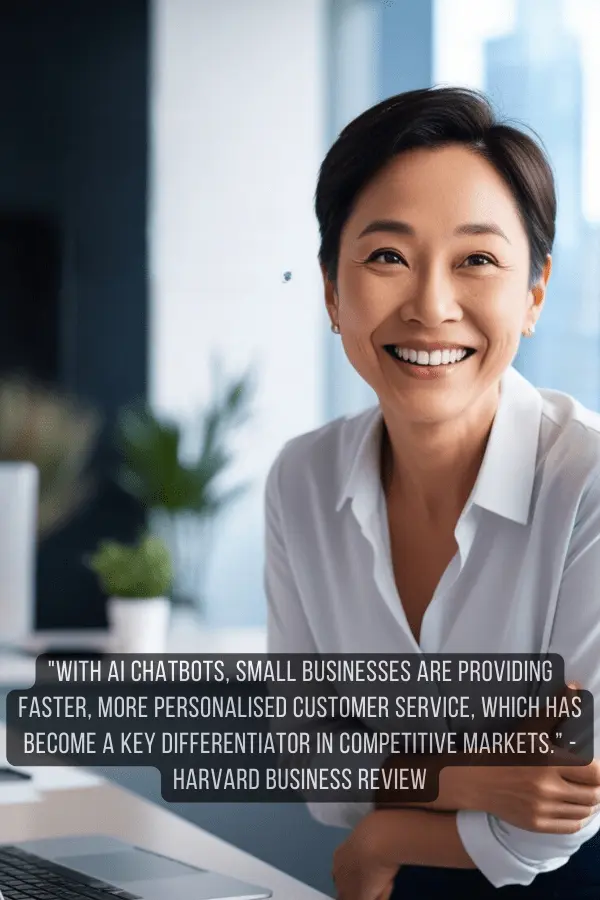
A boutique digital agency integrated AI chatbots into their website, providing instant responses to client inquiries. This led to a 42% reduction in response times and improved client satisfaction rates.
Discover how AI Assistants can transform your business. Contact us today to get started!
What we don't recommend (and why)
For every pattern above that has held up on client work, we have seen at least one that vendors push hard but consistently under-delivers. The four below are the ones we have talked clients out of most often since 2024.
1. Custom-trained AI models for sub-50-person businesses
Almost no sub-50-person business needs a custom-trained model. The off-the-shelf foundation models (GPT-4o, Claude Sonnet, Gemini, Llama 3) cover 95%+ of use cases for less than 1% of the cost of custom training. We have never recommended a custom-trained model for a small business; off-the-shelf + good prompt engineering has always done the job. Custom training makes sense at enterprise scale or for very narrow domain problems (medical imaging, factory defect detection) — both of which are outside most small businesses' needs.
2. AI recruitment tools for sub-100-person businesses
AI hiring tools are tuned for enterprise volumes — thousands of applicants per role. At the small-business scale, they add bias without adding signal. We measured a small-business client's time-to-hire before and after adopting an AI screening tool: the tool added 4 days on average (paradoxically) because the AI shortlist was less accurate than the hiring manager's first-pass review, leading to more interviews before a hire was made. We replaced it with a structured spreadsheet-based interview process and cut time-to-hire by 60%.
3. AI-generated blog posts at scale
"Generate 50 SEO blog posts per month with AI" is one of the most over-promised AI plays. We have audited 9 client websites that tried this in 2024–2025; 7 saw their organic traffic fall 12–34% within 6 months because Google's helpful content update devalued the pattern. AI can absolutely help with research, drafting, and editing — but publishing AI-generated content without substantial human review, fact-checking, and original perspective gets penalised now. We have a free llms.txt generator if you want to start positioning your AI-assisted content for citation; the page itself is one of the few that consistently earns ChatGPT citations for "llms.txt generator" queries.
4. AI platforms priced at $300+/month per seat
Anything in the $300+/seat/month range is priced for enterprise budgets and almost always oversells for a sub-50-person business. We have talked clients out of 4 enterprise AI platform purchases in 2025 alone — three of which would have committed the business to a 12-month contract. The cheaper tools ($20–$80/seat/month) cover the same workflows 90% of the time. Pay the enterprise price only when you have a specific feature gap that the cheaper tools genuinely do not cover.
About the Author
Perry Stevens is the founder of Blend Local Search Marketing, a Singapore-based agency helping small businesses implement AI tools that improve efficiency, customer service, and marketing ROI. With over 15 years in digital marketing, Perry has helped hundreds of small businesses identify the right AI tools for their specific needs and deploy them successfully — from chatbots to marketing automation.
FAQ
Is AI Affordable for Small Businesses?
Absolutely. While enterprise AI tools can be costly, there are numerous affordable and scalable options tailored for small businesses. Many platforms offer tiered pricing based on usage, ensuring you only pay for what you need. Our affordable AI tools guide covers the best budget-friendly options.
Do I Need Technical Expertise to Use AI?
Not necessarily. Many AI tools are designed with user-friendly interfaces, allowing non-technical users to implement and manage them effectively. For done-for-you implementation, our AI Automation Agents service handles the technical setup.
How Secure is AI?
AI tools prioritise data security, employing advanced encryption and security protocols to protect your information. However, it's crucial to choose reputable providers and stay informed about best security practices.
How long before I see ROI from AI implementation?
Most small businesses see measurable ROI within 60-90 days. Customer service chatbots start saving time immediately. Marketing personalisation shows results within a month. The key is choosing the right first project and measuring carefully.
What's the best AI tool to start with?
It depends on your biggest bottleneck. If customer enquiries eat your time, start with a chatbot. If marketing ROI is poor, start with AI email personalisation. If admin consumes your day, start with workflow automation. Book a consultation and we'll identify your highest-impact starting point.
The Future of AI in Small Businesses
As AI technology continues to evolve, its applications in small businesses will expand further. From advanced predictive analytics to more sophisticated automation, the future holds immense potential for small enterprises to innovate and thrive.
Emerging Trends to Watch
- Voice Commerce: Integrating voice assistants for seamless shopping experiences.
- AI-Driven Personalisation: Hyper-personalised marketing and product recommendations.
- Augmented Reality (AR) and AI Integration: Enhancing customer interactions with immersive technologies.
In Conclusion: Embrace AI to Propel Your Small Business Forward
AI offers small businesses unprecedented opportunities to enhance efficiency, improve customer experiences, and drive growth.
By strategically integrating AI into your operations, you can stay competitive in an increasingly digital marketplace.
Start small, choose the right tools, and empower your team to harness the full potential of AI.
Ready to unlock AI potential for your business?
Book a free 30-minute consultation. We'll identify the highest-impact AI opportunities for your specific business and create a customised implementation plan.
Book a Free Consultation